Independent Study · Second Year · Early 2024
The Shield Point System
Decoupling armour from the weapon buy, so the players least able to win a fight are not also the least protected.
The brief was to pick a game, identify a design problem, and propose a solution. I went after eco snowballing and passive play. The thing I kept circling was armour: shields are the first purchase cut on a thin buy, which means the players least able to win a fight go into it with the least protection.
Timing
I spent this term convinced the shield economy was the part of VALORANT due for a rework. That turned out to be the same window Riot was working on regenerative shields, and by about the time I presented this, the regen shield option had shown up in game.
Two different solutions to the same read on the game. It was the first time a conclusion I reached from my own research matched what Riot's designers were already building, in the same window, with no sight of their roadmap.
The Proposal
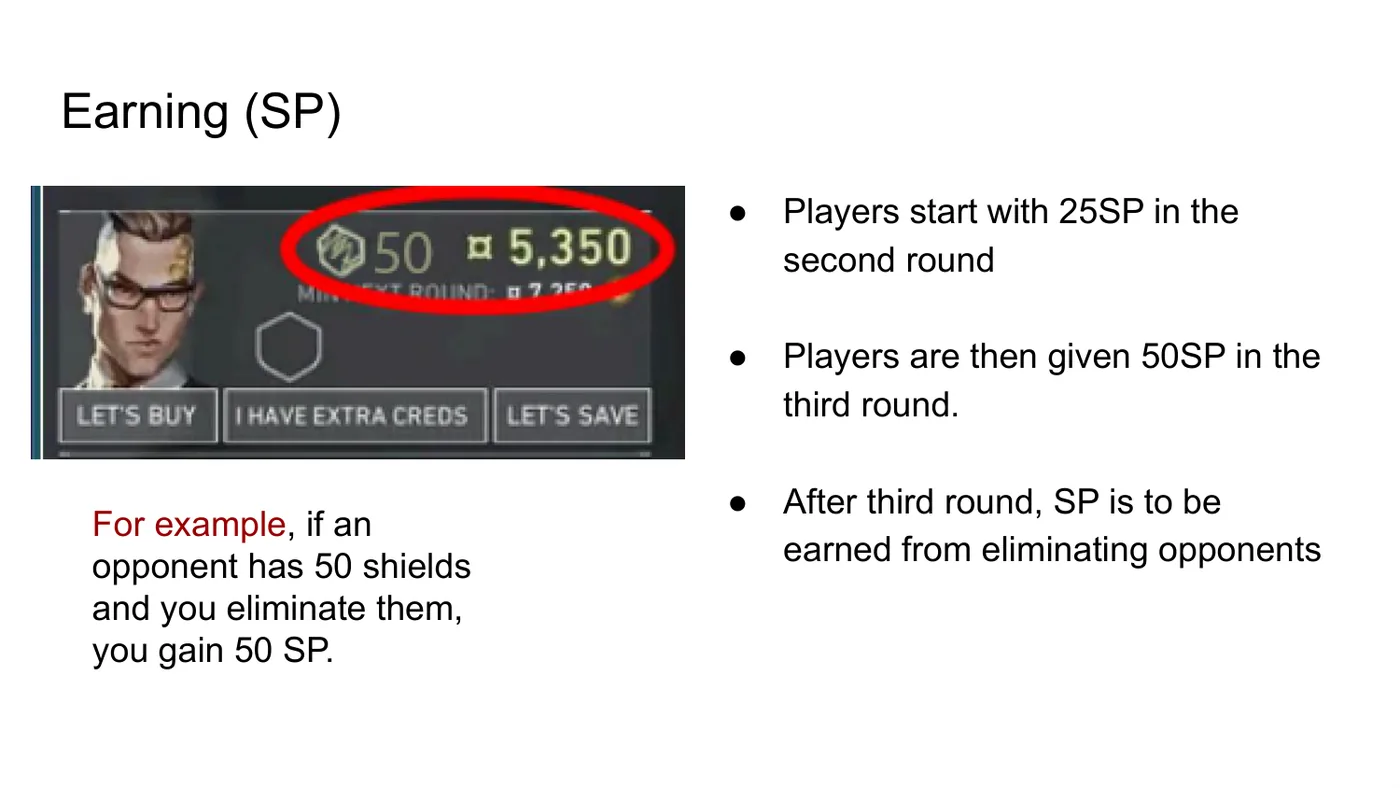
A second currency, armour only. Shield Points sit apart from credits and buy nothing but armour. Players start with 25 SP in round two and 50 SP in round three. After that, SP is earned by eliminating shielded opponents - kill someone carrying 50 shields and you collect 50 SP.
Full shields cost 50 SP, half shields 25 SP, with a 250 SP ceiling and a reset at the side swap. The intent is that a team on a thin economy is never choosing between a rifle and staying alive, and that a passive player has a direct, personal reason to take a fight.
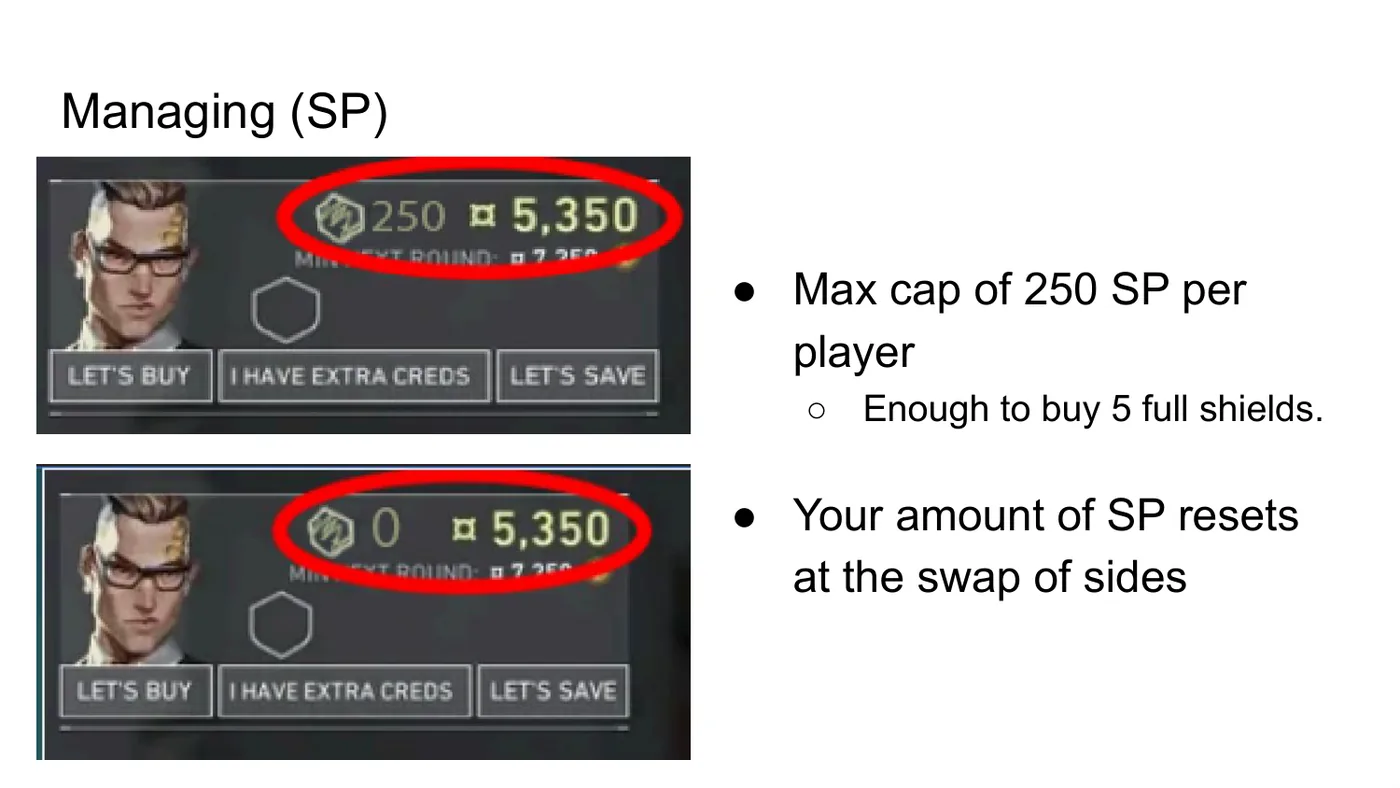
Bounded on purpose. The 250 SP ceiling is roughly five full shield buys, and everything resets at the swap. Both constraints exist to stop the currency becoming a parallel economy that outgrows the credit system it is meant to sit beside.
How I Planned to Test It
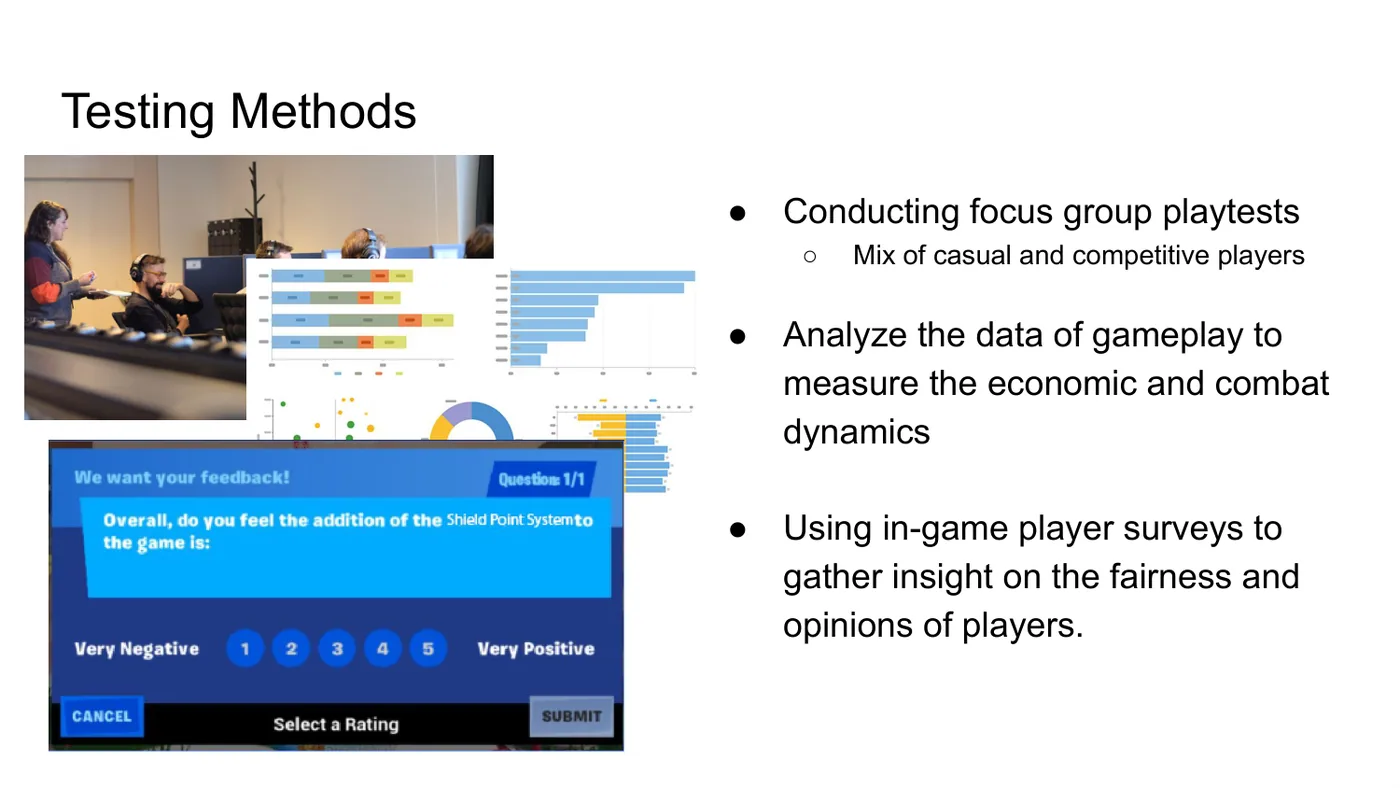
Three metrics - engagement, fairness, satisfaction - measured through focus-group playtests mixing casual and competitive players, gameplay data on economic and combat dynamics, and in-game surveys on perceived fairness.
I built the proposal on comparative research rather than instinct, breaking CS:GO and Apex Legends down by design goals, strengths and weaknesses. CS:GO showed me how a round economy rewards team coordination over individual play. Apex showed me what happens when you tie resources to individual performance instead.
The Tension at the Centre of It
This is the part I would want to talk about first.
The player already winning fights collects more shields, becomes harder to kill, and wins more fights. A system meant to soften the team snowball can sharpen the individual one.
I knew the shape of that risk, because I had written it down myself two slides earlier: my Apex breakdown flags exactly this, that performance-linked resources cause scaling problems where early dominance compounds. That is why fairness is one of the three metrics I defined, and why the testing plan leads with mixed casual-and-competitive focus groups rather than my own opinion.
The version I would build now caps the advantage rather than trusting the 250 SP ceiling to do it: diminishing SP returns per round, so a player having an extraordinary round banks armour more slowly than their first two kills suggest. That is the specific change, and it is the one I would test first.
The finding that surprised me. While researching the problem I found evidence that snowballing in VALORANT is perceived as a bigger issue than it measurably is - teams frequently break a losing streak with two consecutive round wins, and severity varies by region.
I put it in the deck even though it weakened my own premise. It was the first time I ran into a real gap between what players feel and what the data says, and it changed how I scope a problem. A year later the same thing happened again, with snipers.
The Number That Argued Against Me
The proposal exists because eco snowballing felt like VALORANT's unfixed problem. Before defending it I went looking for how bad the snowball actually is, and the answer complicated my own pitch.
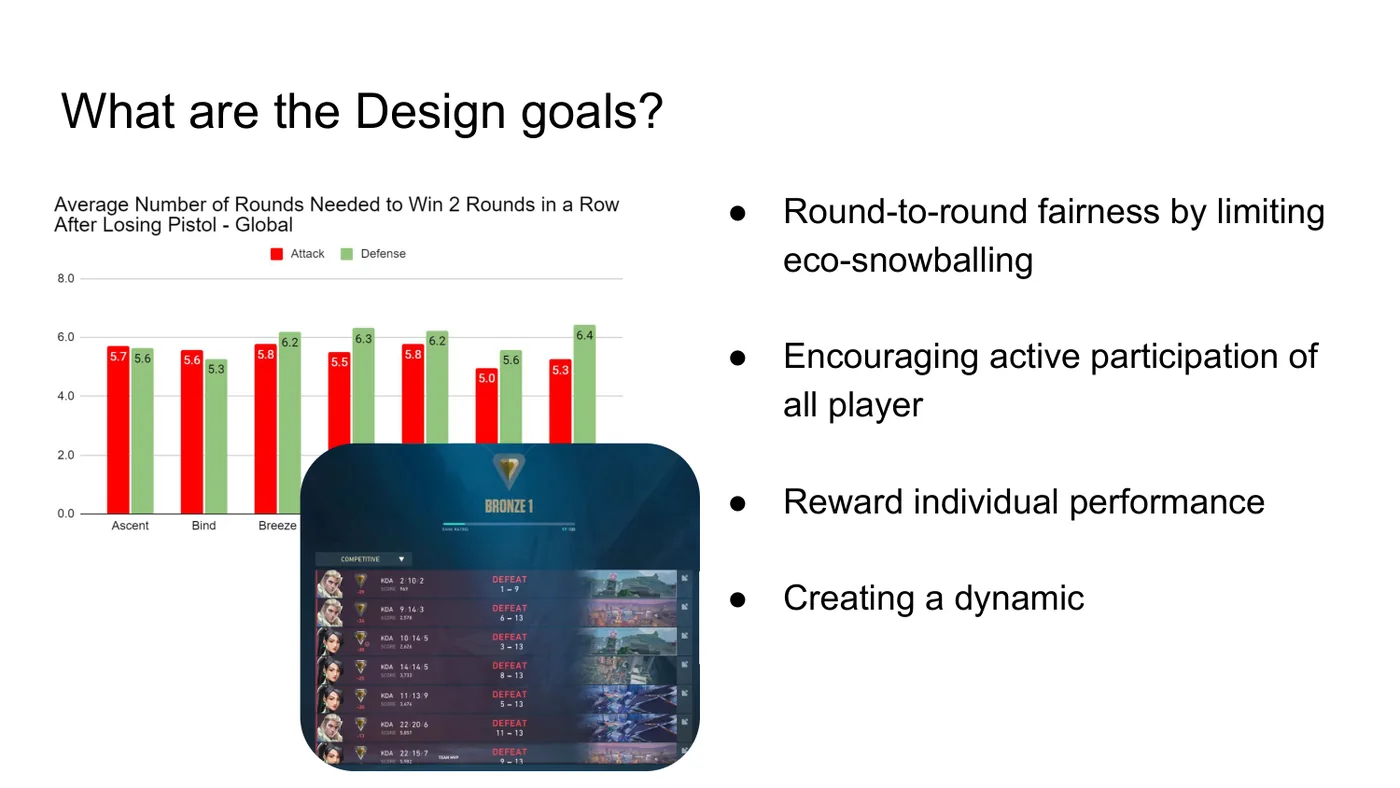
Average rounds needed to win two in a row after losing the pistol, by map and by side. Attack and defence across Ascent, Bind, Breeze, Icebox, Lotus, Split and Sunset. The spread runs from about 4.2 rounds on Split attack to 7.6 on Sunset defence.
Two things fall out of that. Recovery is measured in a handful of rounds rather than a lost half, and it varies enough by map and side that any fix applied uniformly across the game is answering a problem that is not uniform.
What this did to my argumentTeams break a snowball with roughly two consecutive round wins, and the research also showed the degree of snowballing differs by region. Snowballing is perceived as a larger problem than it measurably is, which means part of what I set out to fix was a feelings problem rather than a numbers problem. That distinction matters, because a perception problem and a balance problem call for completely different solutions and I had reached straight for the balance one.
I would still argue the shield-specific point stands on its own. Armour being first on the chopping block during a thin buy is a real and separate issue from how long a snowball lasts, and it is the part of the proposal I would defend without the chart. But the framing I originally led with, that this was primarily an anti-snowball measure, is more than the data supports, and it is the kind of overclaim I now check for before I write the pitch rather than after.
Where the Comparisons Came From
What I studied against
- CS:GO's armour economy. The closest direct comparison, since VALORANT's buy phase is built on the same ancestry. Used to test whether "shields get cut first on a thin buy" is specific to VALORANT's pricing or inherited from the genre.
- Apex Legends' shield system. The opposite model: shields as a lootable, upgradeable, mid-fight resource rather than a pre-round purchase. Used to work out what changes when armour stops being an economic decision and starts being a positional one.
- VALORANT's own live buy menu at the time of writing, for the actual credit values the proposal is built on.
- Published per-map snowball-recovery data, charted above: average rounds needed to win two in a row after losing the pistol round, split by attack and defence across seven maps, plus the regional variation noted in the same research.
This study is a design proposal built on structural comparison, not on measured player data. The 2025 study is the one where I moved to charted numbers, and the difference between the two is deliberate on this site.
Where This Sits
This is one of five VALORANT studies I chose across four years of my Honours Bachelor of Game Design at Sheridan. I picked the same game all four times, and nobody assigned it to me once. Read all five in order →
VALORANT, its characters, art, and related marks are the property of Riot Games, Inc. This is an independent student study, produced for coursework at Sheridan College, and is not endorsed by or affiliated with Riot Games.