A second currency that only buys armour, earned off kills, so shields stop being the first thing cut on a thin buy. Regen shields shipped while I was writing it.
First year, first real systems study. The question I set was blunt: what specifically keeps
players opening a free game every day, and what converts that habit into spending? I picked VALORANT because I had been playing it near daily since I claimed a beta key in the
first hours of the Twitch drops in April 2020, so I could check every claim against my own play.
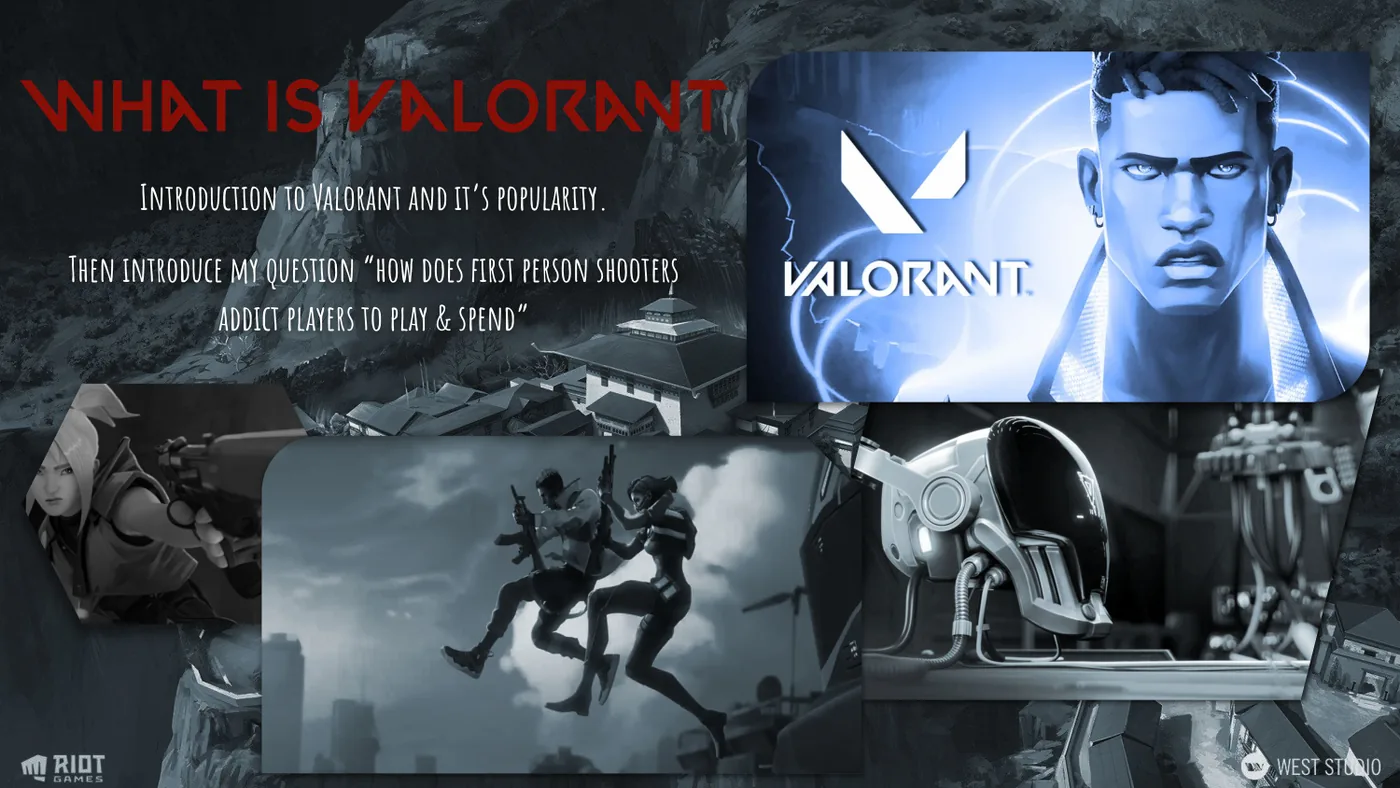
What it covered. The agent roster as a differentiator against CS:GO, the buy menu and
per-weapon economy, gun mechanics and their competitive weight, and then the retention layer: daily
challenges, the ranked system and act rank triangle, and the rotating item shop. The last section dealt
with community and toxicity, including the systems Riot uses to detect and punish it.
I worked from published literature rather than opinion, drawing on research in Frontiers in Psychology
and NCBI on games and compulsive play, plus a study on self-reported addiction among World of Warcraft
players.
Reading this back in 2026
The framing is first-year framing. I set out to catalogue mechanisms that keep players engaged and
treated engagement and compulsion as close to the same thing, which is the easy conclusion rather than
the accurate one. The study is fairer than its framing suggests - a full section covers Riot's
anti-toxicity work - but I would separate those ideas properly if I wrote it now.
What I still stand by is the method: pick the systems, describe them precisely, and check the claims
against sources instead of vibes. That habit is the reason the 2025 study has charts in it.
The brief was to pick a game, identify a design problem, and propose a solution. I went after
eco snowballing and passive play: rounds where a losing team cannot afford to contest, and players who sit
back and let teammates carry the round. The specific thing I kept circling was armour - that shields
were the first purchase to get cut on a thin buy, which meant the players least able to win a fight were
also the ones going into it with the least protection.
I spent that term convinced the shield economy was the part of VALORANT due for a rework.
That turned out to be the same window Riot was working on regenerative shields, and by about the time I
presented this, the regen shield option had shown up in game. Two different solutions to the same read on
the game, and the first time a conclusion I reached from my own research turned out to match what Riot's designers
were already building.
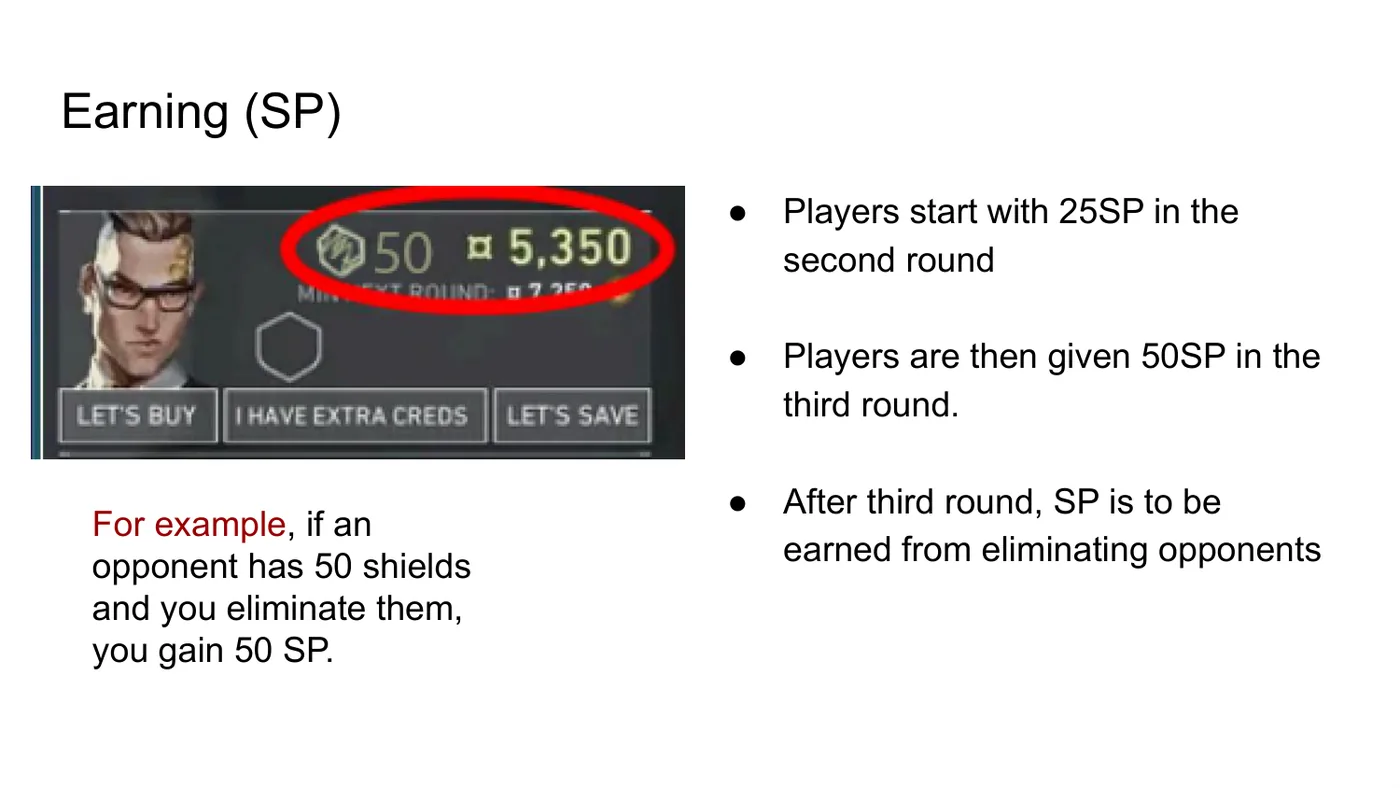
The proposal. A second currency, Shield Points, separate from credits and spendable
only on armour. Players start with 25 SP in round two and 50 SP in round three. After that, SP is earned
by eliminating shielded opponents - kill someone carrying 50 shields and you collect 50 SP. Full
shields cost 50 SP, half shields 25 SP, with a 250 SP cap and a reset at the side swap.
The intent was to decouple armour from the weapon buy so a team on a thin economy is not choosing
between a rifle and staying alive, and to give passive players a direct reason to take fights.
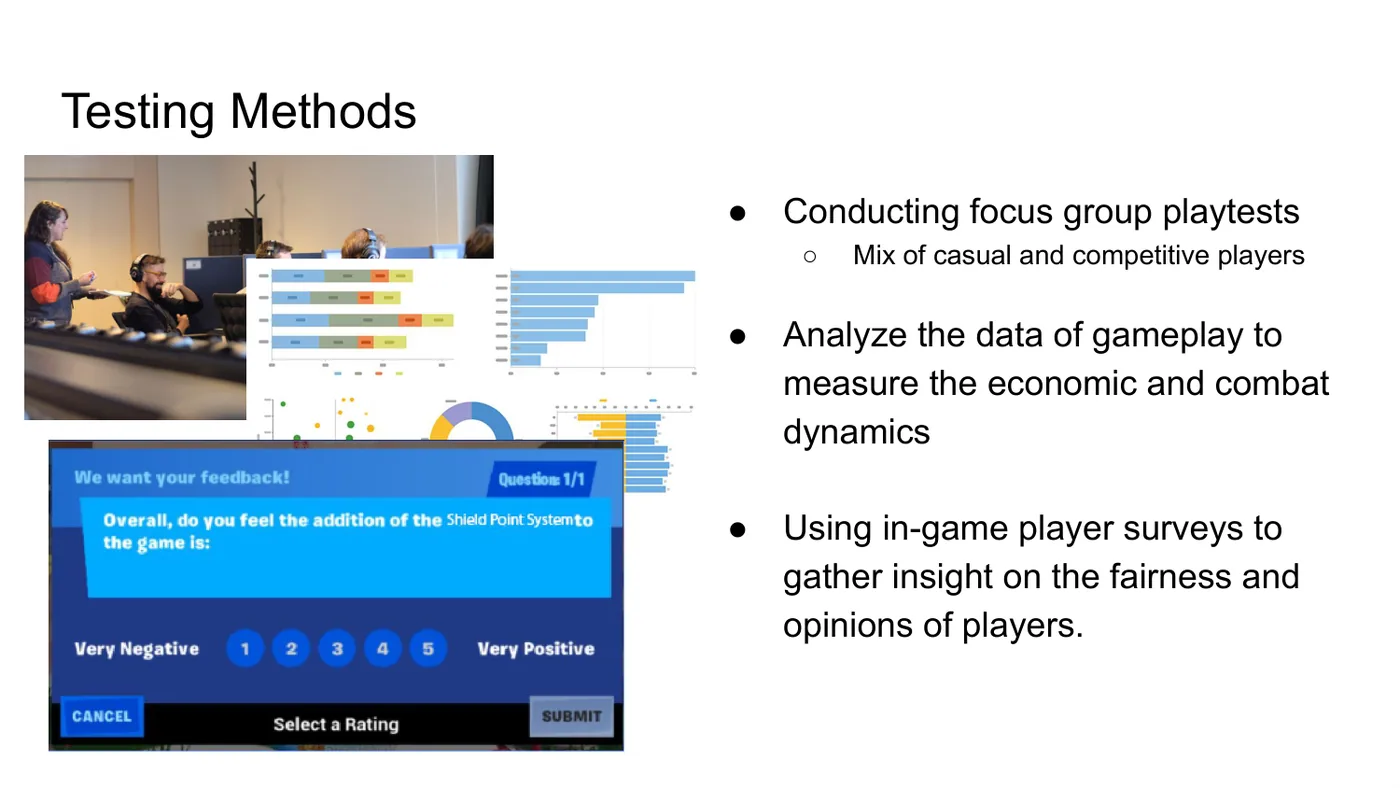
How I planned to test it. Three metrics - engagement, fairness, satisfaction
- measured through focus-group playtests mixing casual and competitive players, gameplay data on
economic and combat dynamics, and in-game surveys on perceived fairness.
I also built the proposal on comparative research rather than instinct, breaking down CS:GO and Apex
Legends by design goals, strengths, and weaknesses. CS:GO taught me how a round economy rewards team
coordination over individual play. Apex showed me what happens when you tie resources to individual
performance.
The tension at the centre of it
Rewarding armour for eliminations creates an obvious risk: the player already winning fights collects
more shields, becomes harder to kill, and wins more fights. A system meant to soften the team snowball
can sharpen the individual one.
I knew the shape of that risk because I had written it down myself two slides earlier - my Apex
Legends breakdown flags exactly this, that performance-linked resources cause scaling problems where
early dominance compounds. That is why fairness is one of the three metrics I defined to evaluate the
system, alongside engagement and satisfaction, and why the testing plan leads with mixed
casual-and-competitive focus groups rather than my own opinion.
The version I would build now caps the advantage rather than trusting the 250 SP ceiling to do it:
diminishing SP returns per round, so a player having an extraordinary round banks armour more slowly
than their first two kills suggest. That is the specific change, and it is the one I would test first.
The finding that surprised me. While researching the problem I found evidence that
snowballing in VALORANT is perceived as a bigger issue than it measurably is - teams frequently
break a losing streak with two consecutive round wins, and the severity varies by region. I put that in
the deck even though it weakened my own premise. It is the first time I ran into a gap between what
players feel and what the data says, and it changed how I scope a problem.
A Design Patterns brief: invent a dark pattern. I built one for VALORANT. Any premium
purchase quietly drops your hidden matchmaking score for a few days, so you go on a tear and credit the
skin, because nothing on screen ever tells you anything about MMR. Then the boost expires and the system
puts you slightly above your real rank instead of back at it. The wins stop. Now you have a very
specific memory of a week where you were good, and exactly one thing you can point to as the cause.
The assignment stopped at inventing it. I kept going. Stopping at "here is something
horrible I thought of" felt like half an assignment, so I designed the version I would actually be
willing to ship: keep the small easing after a purchase, then walk the player back down to their real
skill level and stop there.
All of the harm is in the overshoot. If you land back at your own rank, you tell yourself you were on
a heater and it ended. If you get pushed past it, you tell yourself the game is punishing you for not
spending again. The studio makes the same money either way. Only one version leaves the player
angry.
Why this one matters to me
Most of the class pointed this at a game they had no relationship with, and I think that makes the
exercise too easy. It costs you nothing to be cynical about someone else's game. Aiming it at VALORANT
meant I had to work out where I would actually stop, on the game I would least want to see this used
on.
I expected the fix to need a different system. It needed one number changed. Being able to name that
parameter in a meeting is worth a lot more than saying you are uncomfortable with something.
Third year final project, and the first time I built a redesign on measured data instead of
argument. The subject was VALORANT's round-to-round weapon economy: round win +3000 credits, loss bonus
scaling from +1900 to +2900, +200 per kill, +300 team-wide for a spike plant, against a weapon table where
the Spectre is 1600, the Phantom and Vandal both 2900, and the Operator 4700.
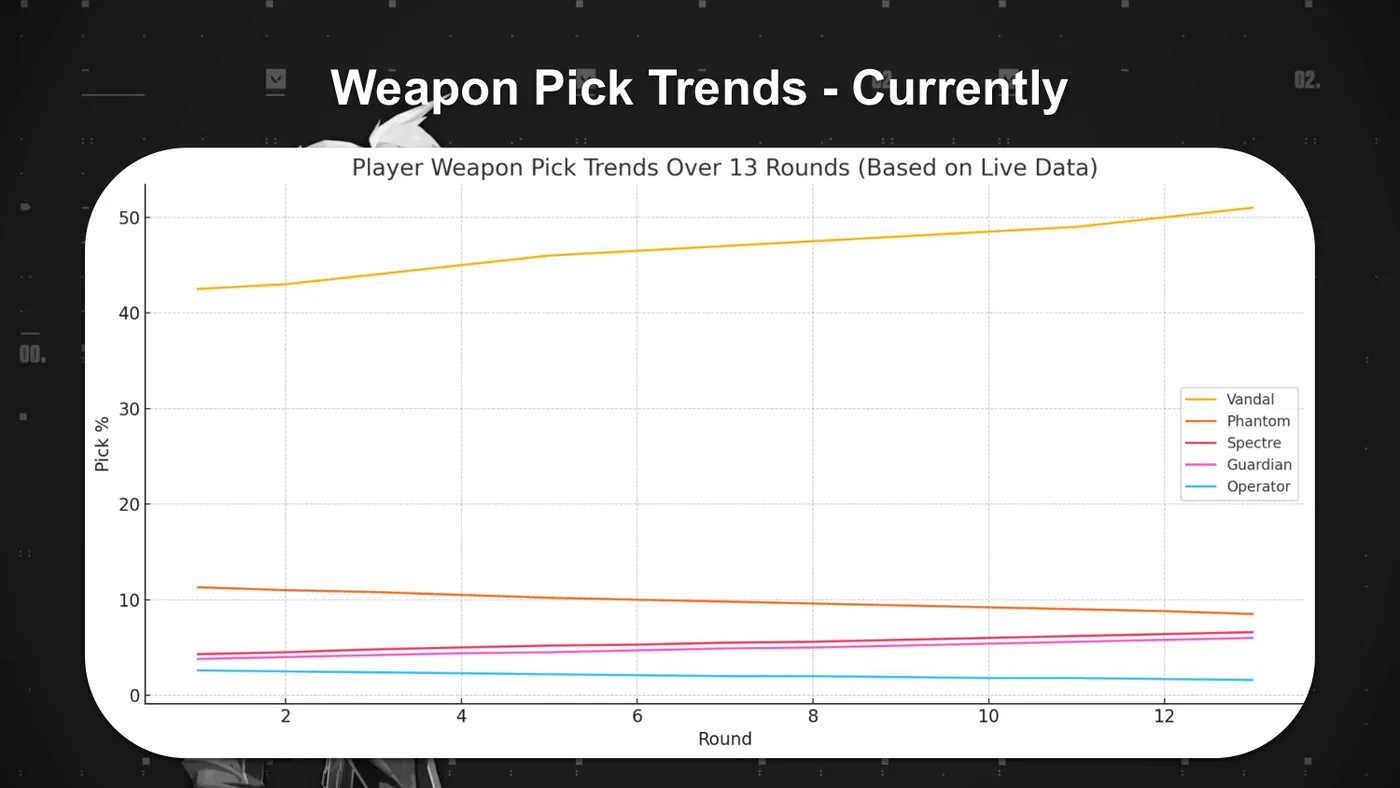
What the data showed. I charted live pick rates across a 13-round half. The Vandal
climbs from roughly 42% to 51% and keeps climbing. The Phantom - the same price, the same slot,
the direct competitor - falls from about 11% to under 9%. The Spectre and Guardian sit in the low
single digits and the Operator barely registers at around 2%.
That is a one-weapon meta at the 2900 tier. Two rifles priced identically, and by the back half of the
round set one of them is picked five times more often than the other. The buy phase presents a choice
that most players have already stopped making.
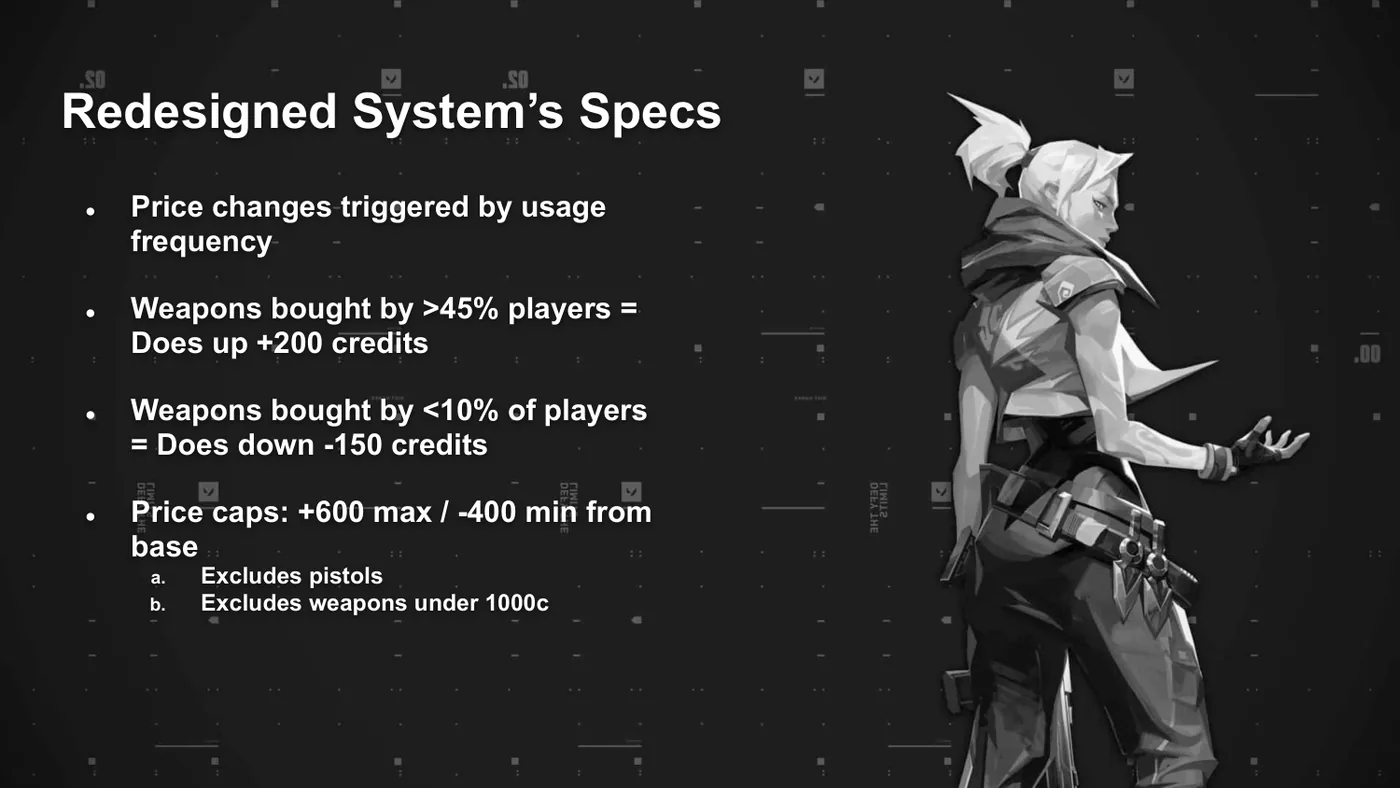
The proposal: usage-driven pricing. Weapon prices move every three rounds based on how
often the weapon is being bought. Above 45% pick rate, the price rises 200 credits. Below 10%, it falls
150. Movement is capped at +600 and −400 from the base price, pistols and anything under 1000
credits are excluded, and players can hover a weapon in the buy menu to see its current price trend.
The goal is not to punish good weapons. It is to put a price on consensus, so that the moment everyone
converges on one rifle, the alternative becomes materially cheaper and the buy phase becomes a decision
again.
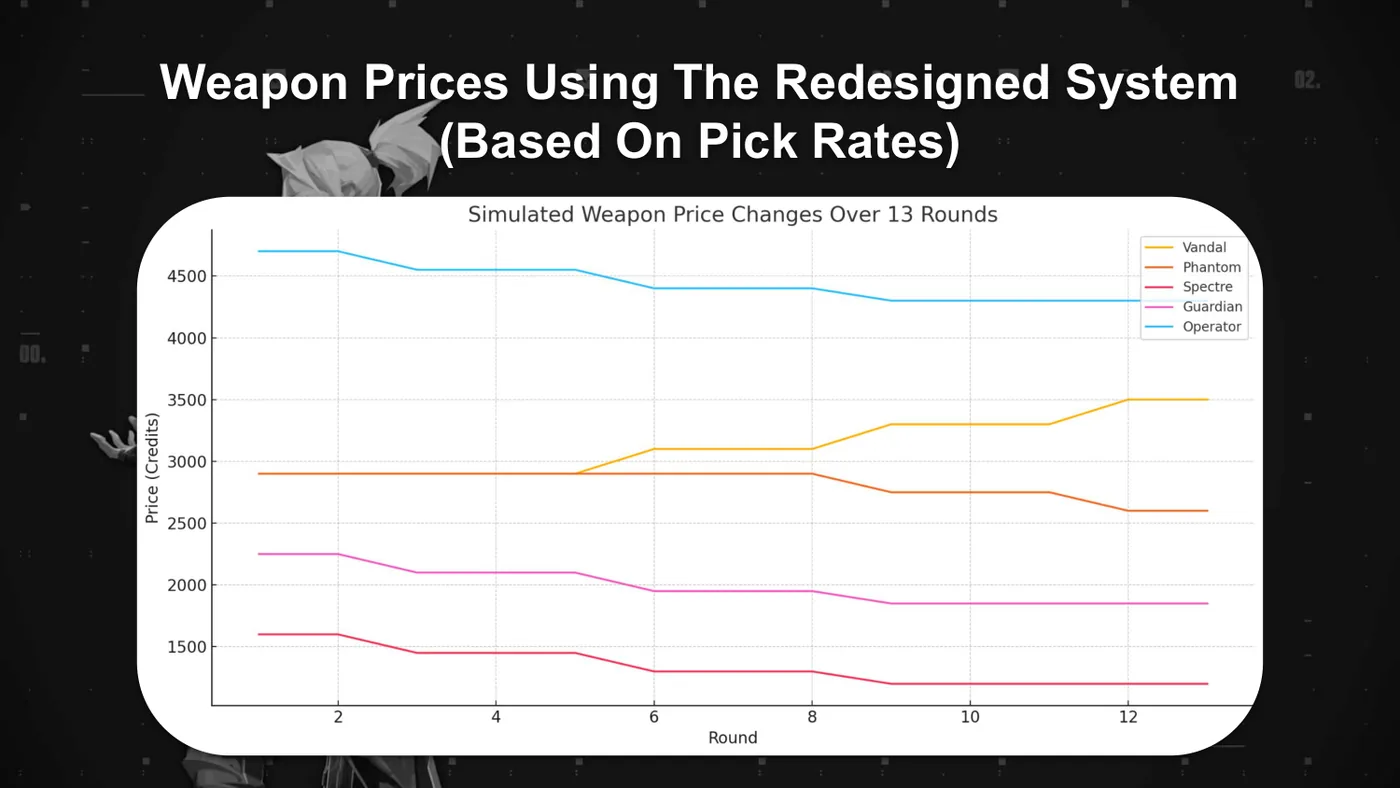
Simulated against the real pick rates. Running the rules over the measured data, the
Vandal walks to its +600 ceiling at 3500 by round 12 while the Phantom settles at 2600. That is a
900-credit gap between two rifles that are identically priced today - enough that taking the
Phantom is a genuine economic decision rather than a preference.
The Spectre and Guardian both fall to their floors, which is the intended behaviour: unpopular weapons
get cheap enough to be worth experimenting with on a thin buy.
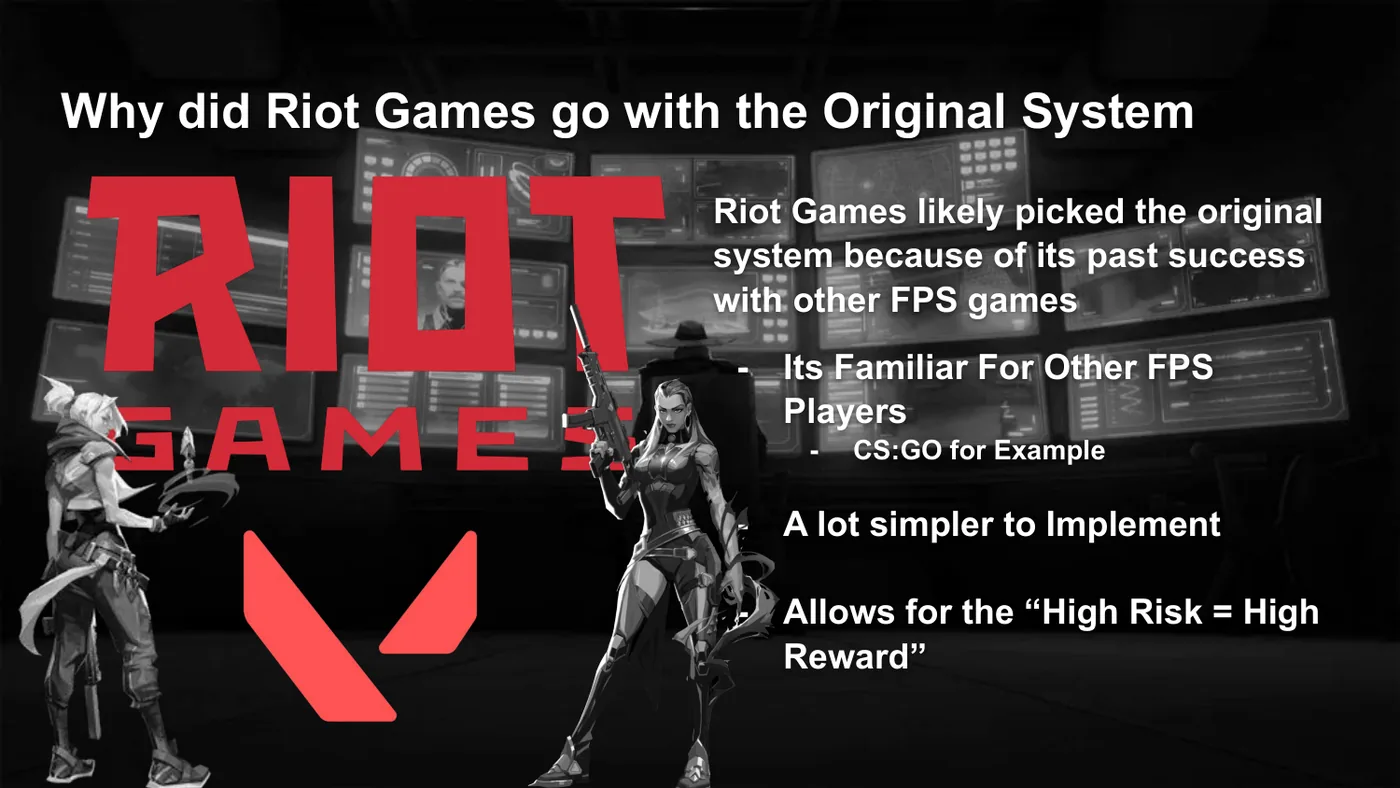
Why Riot's system is the reasonable default. I spent a section of the deck arguing
against myself. A static economy inherits an intuition that CS players already have, which matters
enormously for a game competing directly for that audience. It is far simpler to implement, tune, and
explain. And it delivers a clean high-risk / high-reward read: you know exactly what a buy costs and
exactly what losing it costs you.
Any dynamic system trades that legibility away. I still think the trade is worth testing, but the
burden of proof sits with the change, not the incumbent.
What the data changed about my own argument
The complaint I started with was not the problem. I began this project where most
players begin - snipers, Operators every round, the loudest grievance in any lobby. Then I charted
it. The Operator sits at roughly 2% pick rate, the lowest weapon I tracked, flat across the entire
half. The felt problem and the measured problem were not the same problem.
What the data does show is a one-weapon meta at the 2900 tier, and that is the version of this project
I would defend. It also means the rule set needs a floor exclusion at the top of the weapon table:
discounting a weapon as strong as the Operator purely because it is rarely bought would be the same
mistake in reverse. Exclusion by price band already exists in my spec for weapons under 1000 credits;
it belongs at both ends.
Dynamic pricing is regressive, and that is the real cost. A 200-credit surcharge is
noise to a team on a full buy and decisive to a team scraping toward one. Any serious version has to
answer that - most likely by scaling adjustments against a team's current economy rather than
applying them flat.
The measurement is the design. "Above 45% pick rate" is not a rule until you say
measured across what population and what window. Global rates feel arbitrary in your match; in-match
rates give you ten players over three rounds, where one person can move the whole market. That sentence
is where the interesting work actually lives.
It has an esports cost. VALORANT is a spectator game. A moving economy means teams
prepare against a shifting target and viewers lose a stable frame for reading a buy round. I would ship
this to ranked long before I argued for it in VCT.
The through-line I only noticed later
Both redesigns started from a complaint the community treats as settled - snowballing in 2024,
sniper dominance in 2025 - and both times, when I went and measured it, the data disagreed with
the complaint. Snowballs break faster than players think. Operators are rarer than players think.
I did not set out to learn that twice. But it is the most useful thing these four studies taught me:
player feedback tells you precisely where the pain is, and almost never tells you what is causing it.
Both are worth listening to. Only one of them is worth designing from.
In 2025 I chose my problem before I gathered evidence, then kept the original framing after the
evidence pointed somewhere else. The Vandal-versus-Phantom story was sitting in my own chart the
whole time and it is more interesting than the one I told. Gather first, frame second.
Turn Your Own Critique On Yourself
The 2024 flaw was not a knowledge gap. I had written the exact criticism two slides earlier about
Apex and did not apply it to my own system. Now I read my competitive analysis back against my
proposal deliberately, looking for the place my own argument convicts me.
Argue Against Your Own Design
Writing the section defending Riot's existing economy taught me more than designing the replacement
did. Any proposal that cannot articulate why the current design is reasonable is not finished, and
probably is not right.
Specify the Measurement
A rule that says "above 45% pick rate" is not a design until you say measured over what population,
across what window, with what smoothing. The interesting problems live in that sentence, and I left
it unwritten.
September 2024 - The First Letter
A careers class in second year set an assignment: write a cover letter to someone who
inspires you, at a company you actually want to work for. Most people picked a company they could
plausibly reach. I wrote to Anna Donlon, the executive producer of VALORANT.
It was an exercise. There was no job posting, no opening, nobody on the other end. I
wrote it anyway, because at that point I had already been playing the game for four years and had
already decided where I was aiming. Two years later, in September 2026, I am sending a real one to the
same company for a role that actually exists.
The Economics of Missing Out
A design journal on FOMO, written after I spent $20 on a returning Renegade Raider skin
knowing exactly what the pattern was doing to me. Three games run the same mechanic through different
machinery: Fortnite hides the return date, VALORANT states in writing that bundles never come back, and
Rust hands enforcement to the Steam Community Market and lets players do it to each other.
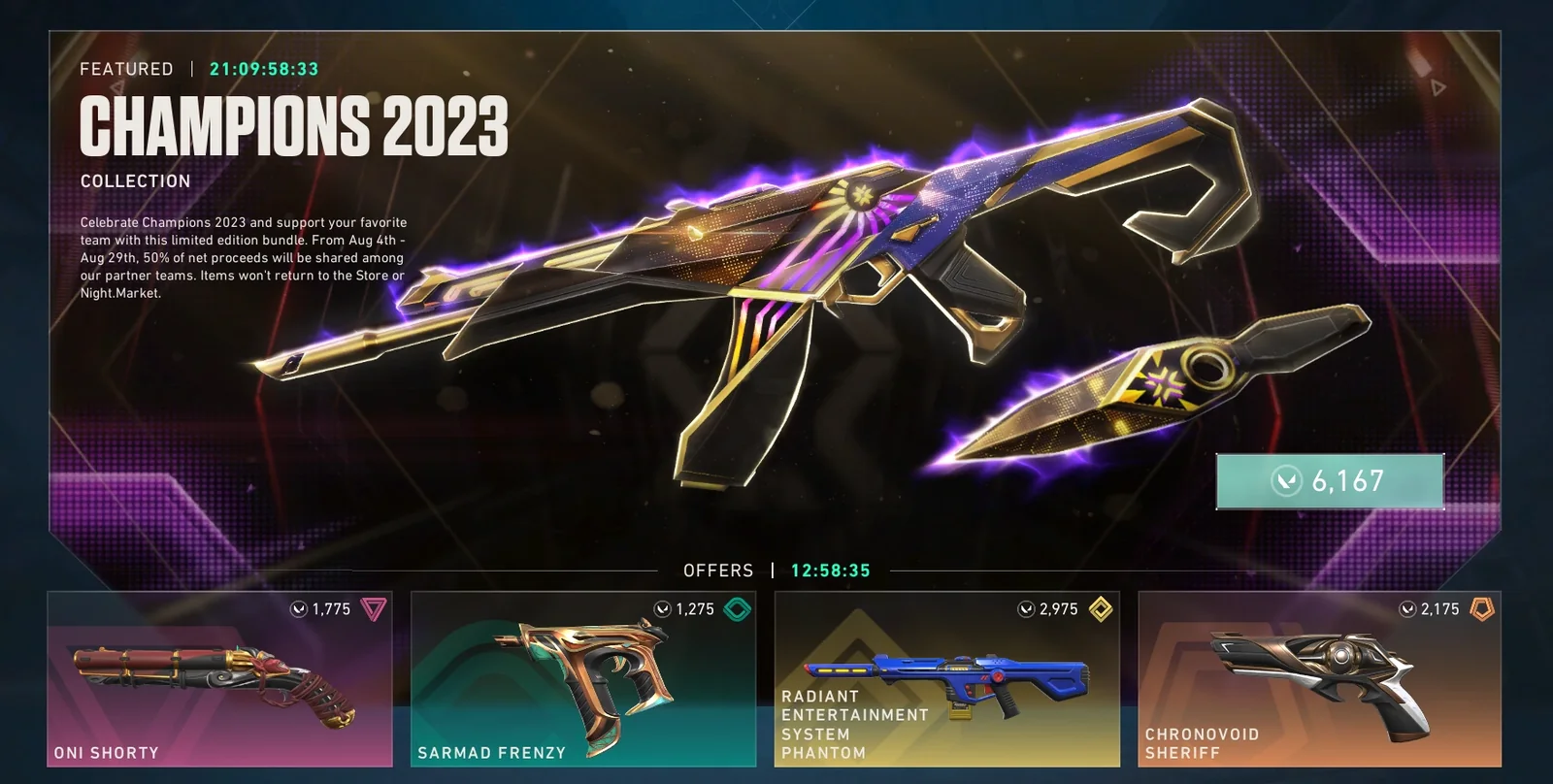
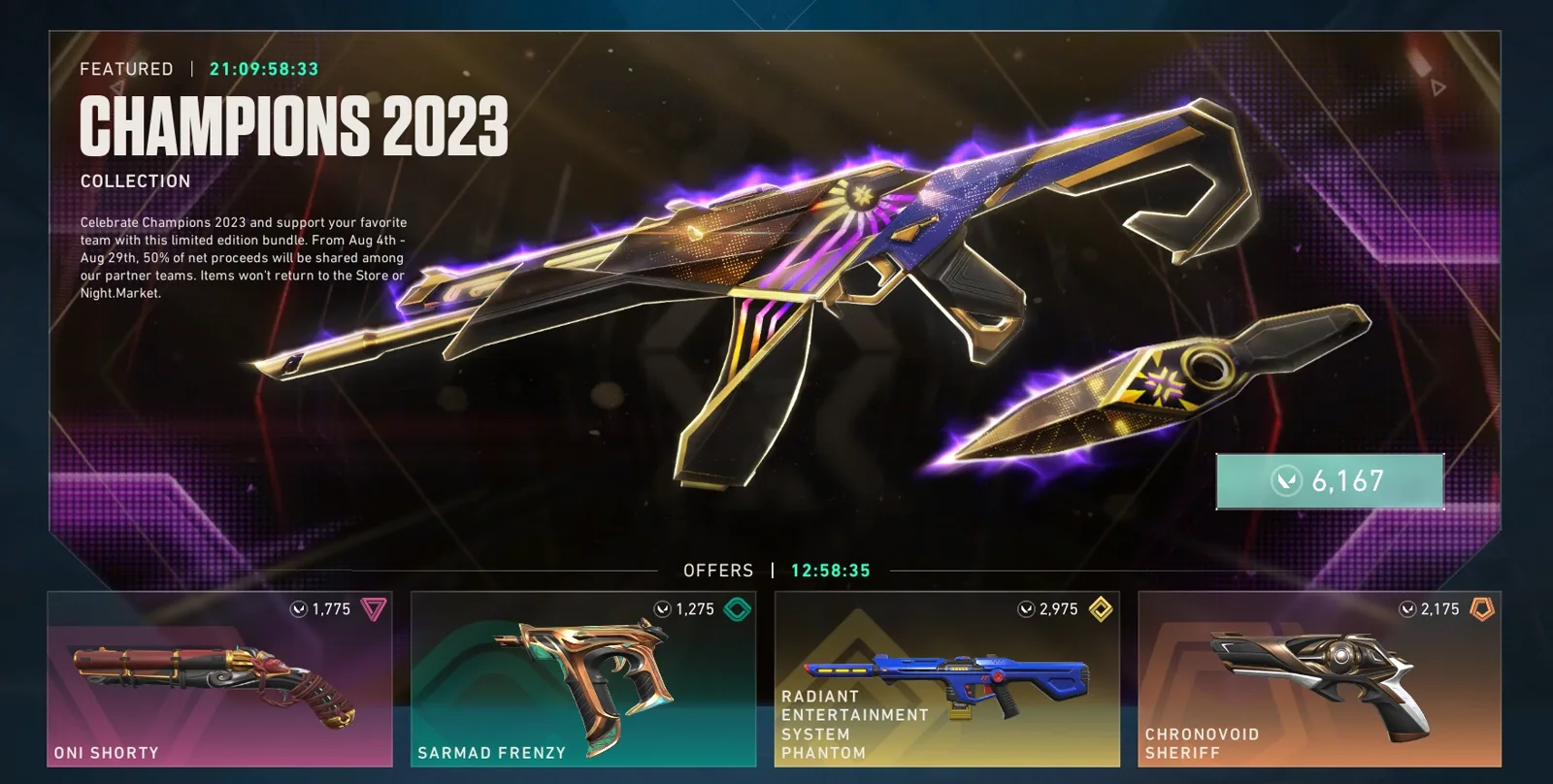
Riot writes the mechanic into the product description. Under the Champions 2023
bundle: "Items won't return to the Store or Night.Market." That sentence is doing two jobs at once. It
is a purchase driver, and it is a guarantee that what you bought cannot be devalued by a reissue
later.
Fortnite never made that promise, which is how it could reissue Renegade Raider and delete the
scarcity its own players had been paying for. The difference between the defensible version of this
pattern and the manipulative one turned out to be one line of copy.
I got my beta key in the first hours of the Twitch drops in April 2020 and have played close
to daily since - roughly six years, peaking at Ascendant 2. In 2025 I went to two days of VCT Masters
Toronto, including the final where Corrode was revealed, and to the developer panel, where I got to talk to
people on the VALORANT team about work they had been carrying for years. Watching a map land in front of
that crowd is the clearest picture I have of what this job actually produces.
The Riot Gun Buddy
I carry a Riot Gun Buddy. It is not purchasable, not in the store, not in the battle pass, not in
Night Market. The only way to get one is for a Rioter to decide you are the kind of player they want
representing the community and hand it to you. It is one of the rarest items in the game. Mine came
from Morgan Ling in 2022.
I mention it because it is the one credential here that I could not study my way into. Somebody at
Riot watched how I behaved around other players and decided that was worth something.
Why Anti-Virus Squad is an Unreal project. When my capstone team was picking
an engine, I pushed hard for Unreal, and my reasoning was not neutral. VALORANT runs on Unreal, and so does
the MMO the team has been building in that universe. I got those eight months. I have been on Anti-Virus
Squad since the first project setup: enemies, shooting, the firewall defence features, replication and the
shop economy. Everything I designed I also built, and I implemented other designers' features in engine as
well. I built the LAN and online setup we ran at Level Up Toronto, and I own the release builds and the
Steam pipeline. I am not going to be learning this toolchain on Riot's time. That was a deliberate bet on
this application, made two years before I could apply for it.
I also make VALORANT content. My channel is mostly performance videos,
the practical how-do-you-actually-get-better kind, plus edits. One of them is the story of getting that gun
buddy. Teaching a mechanic to someone who is stuck on it is the fastest way I know to find out whether I
actually understand it.
Everything on this page was self-directed. Each assignment let me choose a game, and I chose
the same one every time.
VALORANT, its characters, art, and related marks are the property of Riot Games, Inc.
These are independent student studies, produced for coursework at Sheridan College, and are not endorsed by
or affiliated with Riot Games.