Design Journal · Third Year · Game Design Patterns
The Economics of Missing Out
FOMO as a monetization pattern in Fortnite, VALORANT and Rust, written by someone who has paid for it more than once.
FOMO is the pattern where a designer manufactures a deadline so that not buying becomes a decision with a cost. It is the most effective monetization tool in live service games and it works on people who know exactly how it works, which I can confirm personally, because it has worked on me.
I picked three games I actually play, all running the same pattern through completely different machinery: a rotating shop, a bundle that never returns, and a real-money resale market. Comparing them is what makes the pattern legible, because the variable that changes between them is where the scarcity lives.
Case Study: One Pattern, Three Machines
Each game answers the same design question differently: what exactly is the player afraid of losing, and who is enforcing it.
01 Why I am a bad neutral observer, on purpose
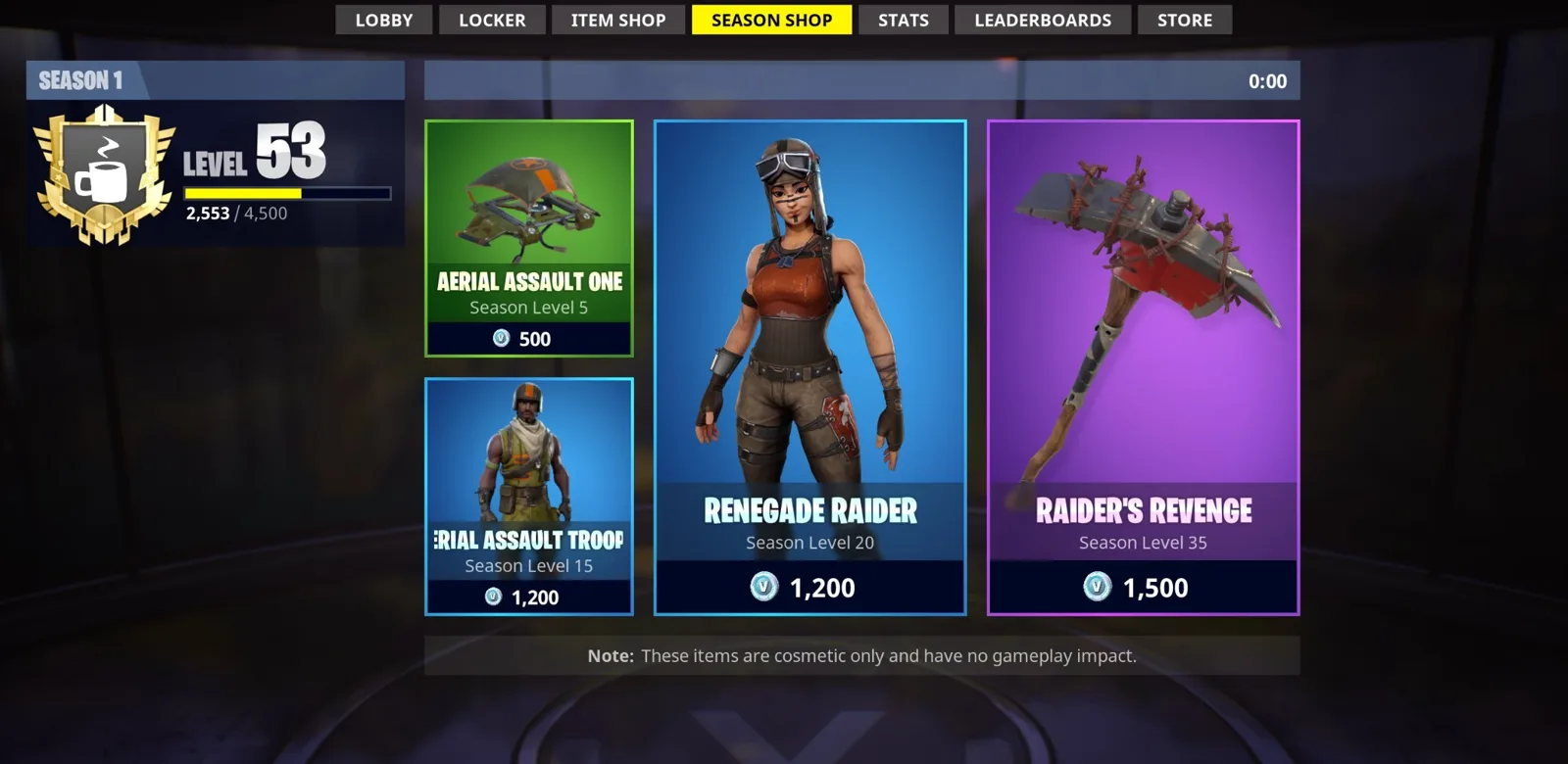
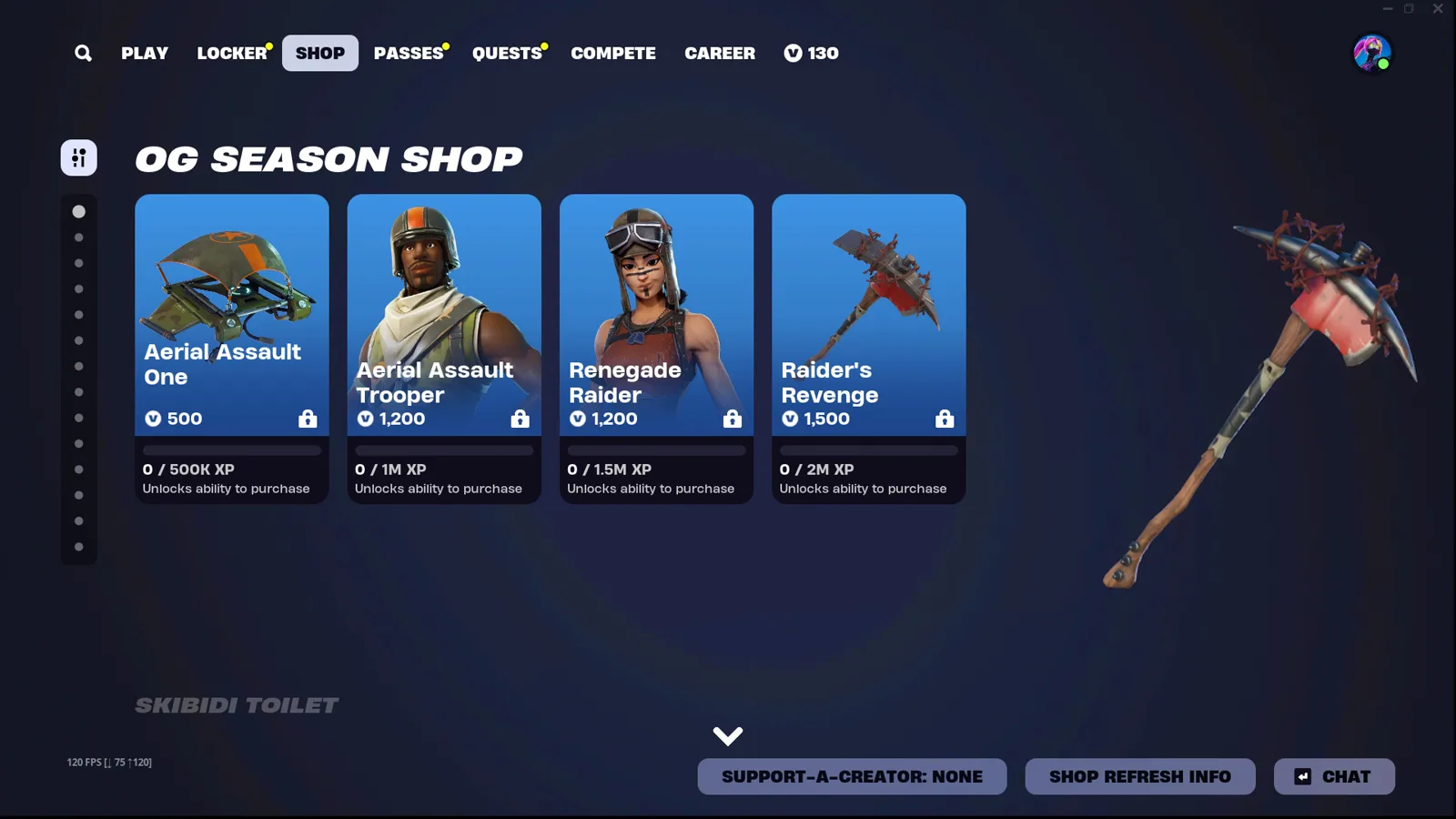
The honest disclosure first, because it's the thing that makes the rest of this useful. A few months before I wrote this, Renegade Raider came back to Fortnite's shop after seven years out of circulation. It was the single most recognisable "I was there" skin in the game, and owning it was the point of owning it.
I spent $20 on it inside the window. The value evaporated on contact, because the entire worth of the item was its scarcity, and the act of selling it to me destroyed exactly that. I knew this while I was buying it. I bought it anyway.
Why that matters for the analysisA designer who has never fallen for the pattern tends to describe it as a trick played on careless people. It is not. It works on informed players, in real time, against their own stated judgement, which is precisely what makes it worth taking seriously as a design tool rather than dismissing.
02 Fortnite: scarcity by rotation
Fortnite's item shop rotates daily and nothing states a return date. Collaboration skins from Marvel, Star Wars and others cycle out and may not reappear for years. The pressure comes from uncertainty rather than from a stated deadline, which is a meaningfully different mechanism than it first appears.
An explicit deadline is a fact you can plan around. An unknown one cannot be planned around at all, so the only strategy that protects you from regret is buying now. The absence of information is the pressure.
The cost of cashing it inReissuing OG cosmetics spends the reputation the pattern runs on. Every player who watched Renegade Raider return now prices in the possibility that anything can return, which weakens every future rotation. Fortnite's version of FOMO depends on a promise Epic never actually made and has now partly broken.
03 VALORANT: scarcity as a stated contract
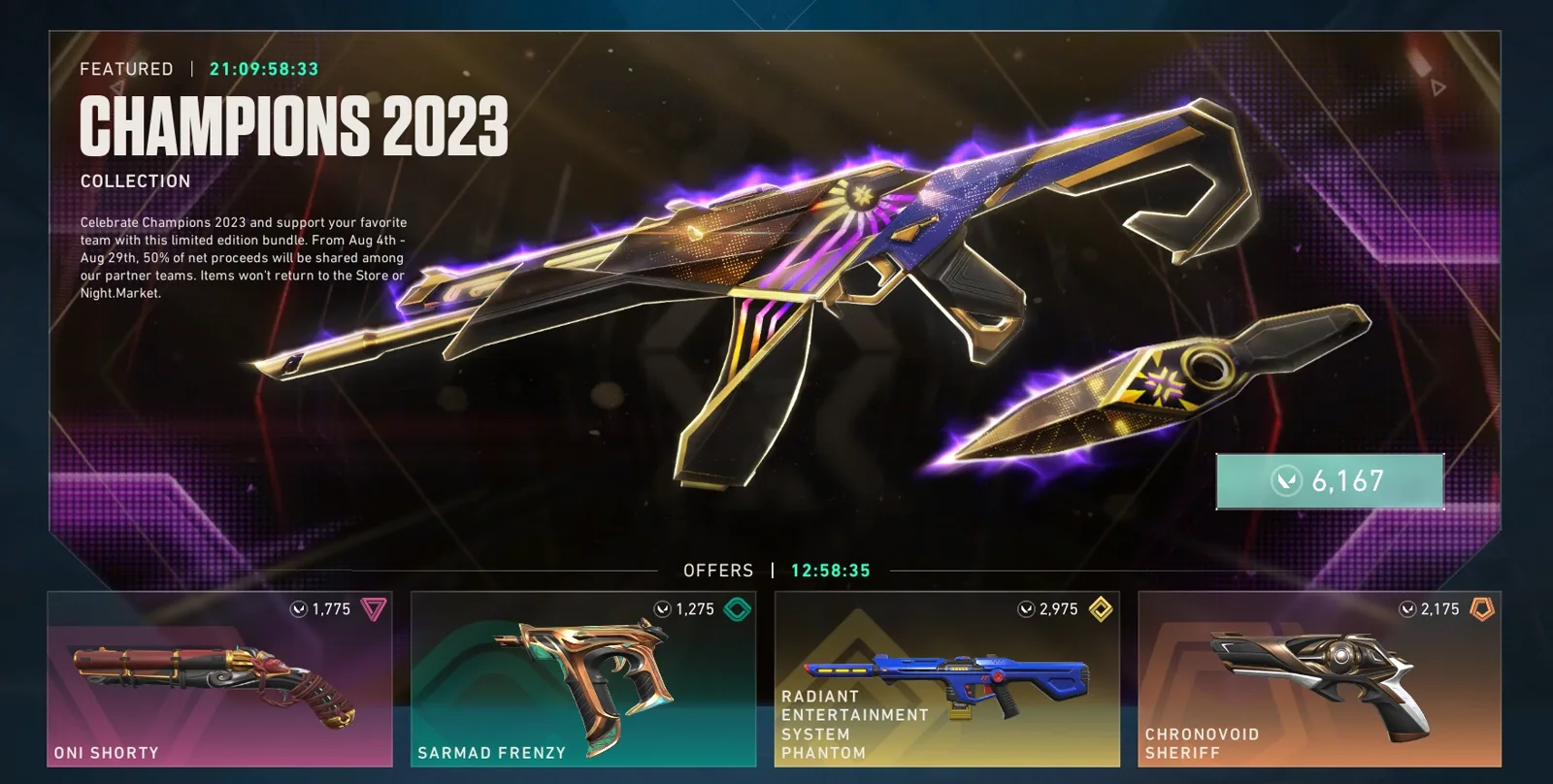
Riot runs the opposite strategy and it is, in my view, the more coherent design. VALORANT bundles do not come back. At most a single item might resurface in a Night Market at an unspecified date, but the complete set is gone, and Riot says so in the product description rather than letting players infer it.
Read the fine print under the bundle. "Items won't return to the Store or Night.Market." Riot is not hiding the mechanic. They are writing the scarcity into the product copy as a feature, next to a countdown clock and a 6,167 VP price.
Two things are happening at once and both are deliberate. The sentence is a purchase driver. It is also a guarantee, and a guarantee is exactly what Fortnite just spent. A player who buys Champions 2023 knows what they own and knows it cannot be devalued by a reissue later.
The same structure runs through the battle pass, where weapon skins, sprays, player cards, titles and gun buddies lock permanently at the end of the act, and through VCT bundles where the scarcity carries an additional layer: the skin is tied to a specific tournament year that will never happen again.
04 Rust: scarcity handed to the market
Rust is the outlier and it is the one that reframed the pattern for me. Facepunch sells skins in a timed in-game store, then removes them. Everything after that happens on the Steam Community Market, where players resell to each other at whatever price the market sets.
Facepunch does not enforce scarcity after the sale. They create it once and hand enforcement to the players, who then do it to each other far more effectively than a publisher could.
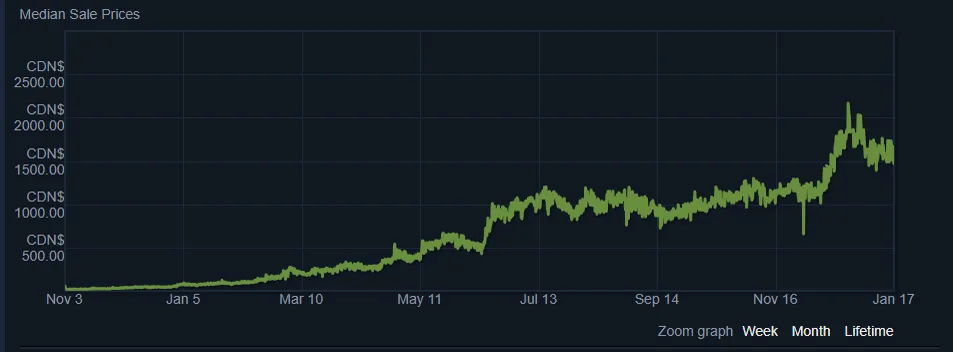
Steam's own median sale price chart for a single Rust cosmetic. It sold for about $19 and now trades around $1,700, with the steepest climb long after the item left the store.
This changes what the player is afraid of. In Fortnite and VALORANT the fear is missing an experience. Here it is missing an investment, which recruits a different and stronger motivation: not regret, but the feeling of having been financially stupid. That is a harder pressure to argue yourself out of.
Where Rust's FOMO is weakestIts seasonal events, Winterfest, Haunted Halloween, Easter, generate almost none of it. They run every year and the rewards get wiped with the biweekly server wipe anyway. Guaranteed return plus guaranteed deletion equals no scarcity, which is a clean natural experiment: the same studio, the same players, the pattern removed, and the pressure disappears with it.
05 What I actually think
I do not think FOMO is automatically unethical, and I do not think the three implementations here are equivalent. Ranking them by how honest they are with the player, Riot comes out ahead, which is not the answer I expected when I started.
Stated scarcity is defensible. Riot tells you the item will not return and then honours it. You are making an informed decision under a real constraint, and the thing you bought keeps the property you bought it for. There is pressure, but no deception.
Ambiguous scarcity is not. Fortnite never promises anything, which means it extracts urgency from a fear it also reserves the right to invalidate. My $20 bought an item whose value the seller destroyed in the same transaction, and nothing about that was against the rules, which is exactly the problem.
Market scarcity is the one I'd refuse to build. Once cosmetics have resale value, you are no longer selling a hat, you are running a speculative asset with teenagers in it. The design is elegant and I would not ship it.
For my own work the conclusion is simple enough to hold on to: I would not use FOMO as a monetization strategy. Not because it fails, it plainly works, but because the version that works best is the version that leaves the player feeling worst, and I would rather have the constraint than the revenue.
The connected thought, and the reason this study sits next to the others on this site, is that this is the same question as the matchmaking dark pattern study: you can usually keep the commercial upside and delete the harm, and the difference between the two versions is smaller than people assume. Here it is one sentence in the product description.
Sources
- VALORANT in-client store, Champions 2023 collection page, including the stated non-return clause and the 6,167 VP bundle price.
- VALORANT Arcane collaboration pass item breakdown and availability windows.
- Fortnite Season 1 shop (2017) and the OG Season Shop reissue (2025), compared directly.
- Steam Community Market median sale price history for the Rust cosmetic charted above.
- My own purchase history, which is where the Renegade Raider figure comes from.
Where This Sits
This was a design journal for Game Design 6: Design Patterns, the same course that produced the Matchmaking Manipulation study. The course also covered feedback loops, cursed problems, ludonarrative patterns and accessibility, and the habit it built was looking at a live commercial system and asking what it is actually optimising for. All five VALORANT studies →
VALORANT, Fortnite, Rust and related marks are the property of their respective owners. This is an independent student study produced for coursework at Sheridan College and is not endorsed by or affiliated with Riot Games, Epic Games or Facepunch Studios.