
Independent Study · Third Year Final · Late 2025
The Collapse of the Market
Redesigning VALORANT's weapon economy around usage-driven dynamic pricing, tested against live pick-rate data.
VALORANT's economy pays +3000 for a round win, a loss bonus scaling from +1900 to +2900, +200 a kill and +300 team-wide for a spike plant, against a weapon table where the Spectre is 1600, the Phantom and Vandal are both 2900, and the Operator is 4700. Those numbers have barely moved in years. I wanted to know what happens if the prices themselves respond to how players actually buy.
How I Got to This Question
The brief did not say "redesign VALORANT's weapon economy." It said pick a live system and make an argument about it. Everything below is the part of a case study that usually gets skipped: how a broad assignment turned into one narrow, testable claim.
01 The assignment
Third year final. Choose a shipped game, identify something in it you believe is working badly, and propose a change you can defend. The only hard requirement was that the argument had to hold up to being attacked, which is why a whole section of this page exists to attack it.
02 Why VALORANT, and why the weapon table
VALORANT because I have played it since beta and I did not want to spend a final project learning a game from the outside. Within VALORANT there were three things I could have gone after: agent balance, map design, or the economy. I took the economy for a practical reason. It is the only one of the three where the design is literally a table of numbers, which means a proposal can be simulated instead of argued about.
The scoping decisionI narrowed from "the economy" to "weapon prices specifically" after the first chart. Round rewards and loss bonuses are entangled with round structure and I could not change one without modelling all of it. Weapon prices are an isolated variable, so they were the piece I could actually test inside one term.
03 The method
I charted pick rates for five weapons, the Vandal, Phantom, Spectre, Guardian and Operator, across a 13-round half, which is one complete competitive half and the natural unit of a VALORANT economy cycle. Those five cover the two contested price tiers plus the weapon players complain about most, so the sample is deliberately weighted toward where an argument was likely to be.
Then I wrote the pricing rules as something a computer could execute rather than something a reader could interpret: adjust every three rounds, +200 above a 45% pick rate, −150 below 10%, capped at +600 and −400 from base, nothing under 1000 credits eligible. I ran those rules over the measured rates round by round and charted what the prices would have done. Both charts on this page come out of that simulation, which is why they cover the same 13 rounds.
What this method can and cannot tell youIt can show that the rules produce a coherent price curve rather than oscillating or running away, which is a real result and the thing I was checking. It cannot tell you whether players would change what they buy in response, because that needs a build and a playtest, not a spreadsheet. Everything on this page is a model, and I would rather say that clearly than imply I tested it on people.
Where the numbers came from
- Blitz.gg - aggregated VALORANT weapon pick-rate data. Blitz publishes usage statistics collected from the matches of players running its overlay, which is why the rates reflect real ranked play rather than a curated sample.
- Tracker.gg - cross-referenced against Blitz for the same weapons, so a trend appearing in one source could be checked against the other before I built anything on it.
- VALORANT's live buy menu for the base credit values the simulation adjusts from: Spectre 1600, Phantom and Vandal both 2900, Operator 4700.
Both sources are third-party aggregators, not Riot. They sample the players who use their tools rather than the whole playerbase, and neither publishes its exact methodology, so I treat the rates as directionally reliable rather than precise. The argument on this page depends on the gap between the Vandal and the Phantom being large and widening, which both sources agreed on, not on any single percentage being exact.
The Proposal
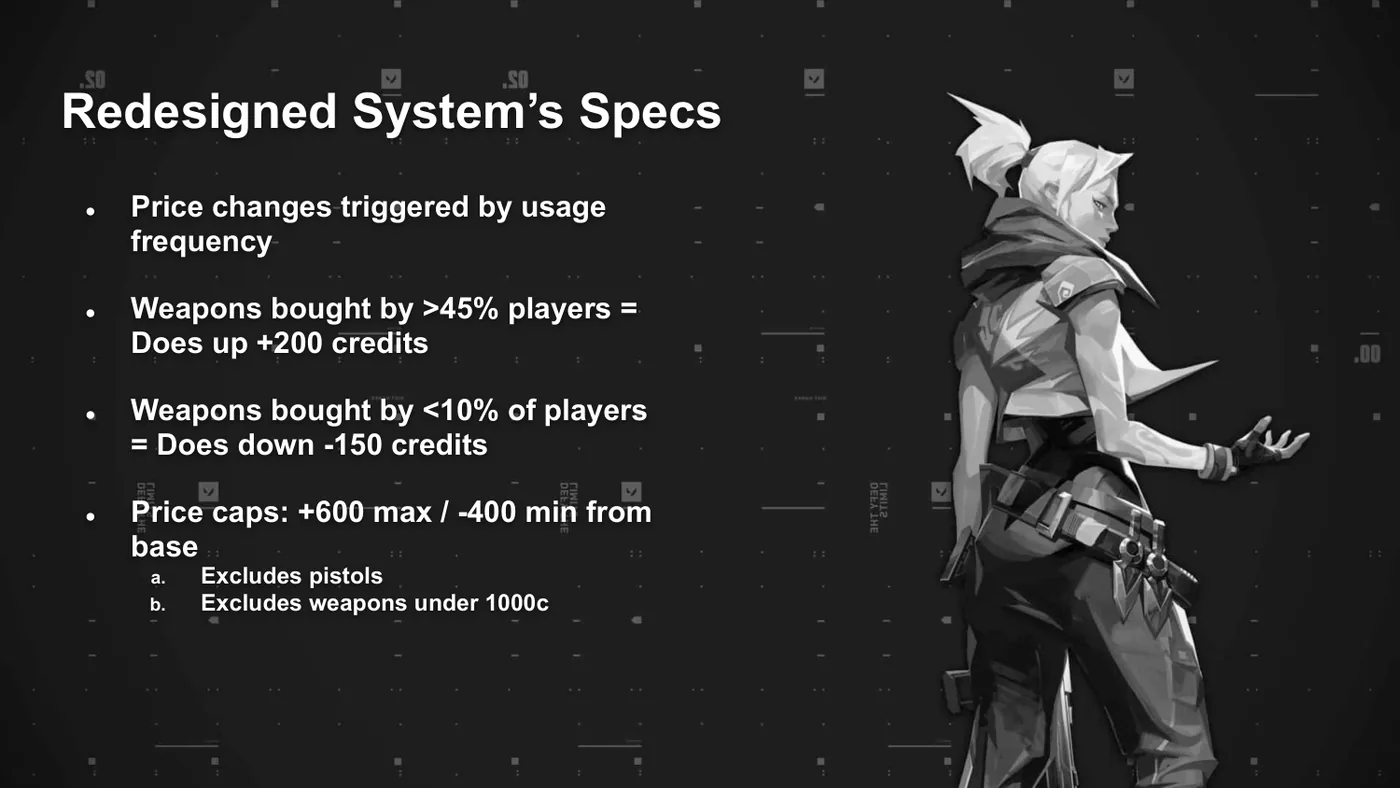
Prices that move with the meta. Every three rounds, weapon prices adjust against how often each weapon is being bought. Above a 45% pick rate a weapon rises 200 credits; below 10% it falls 150. Movement is capped at +600 and −400 from base, pistols and anything under 1000 credits are excluded, and players can hover any weapon in the buy menu to read its current trend.
The goal is not to punish good weapons. It is to put a price on consensus - so the moment a lobby converges on one rifle, the alternative becomes materially cheaper and the buy phase turns back into a decision.
What the Data Showed
Before designing anything I charted live pick rates across a 13-round half. This is the chart that changed the project.
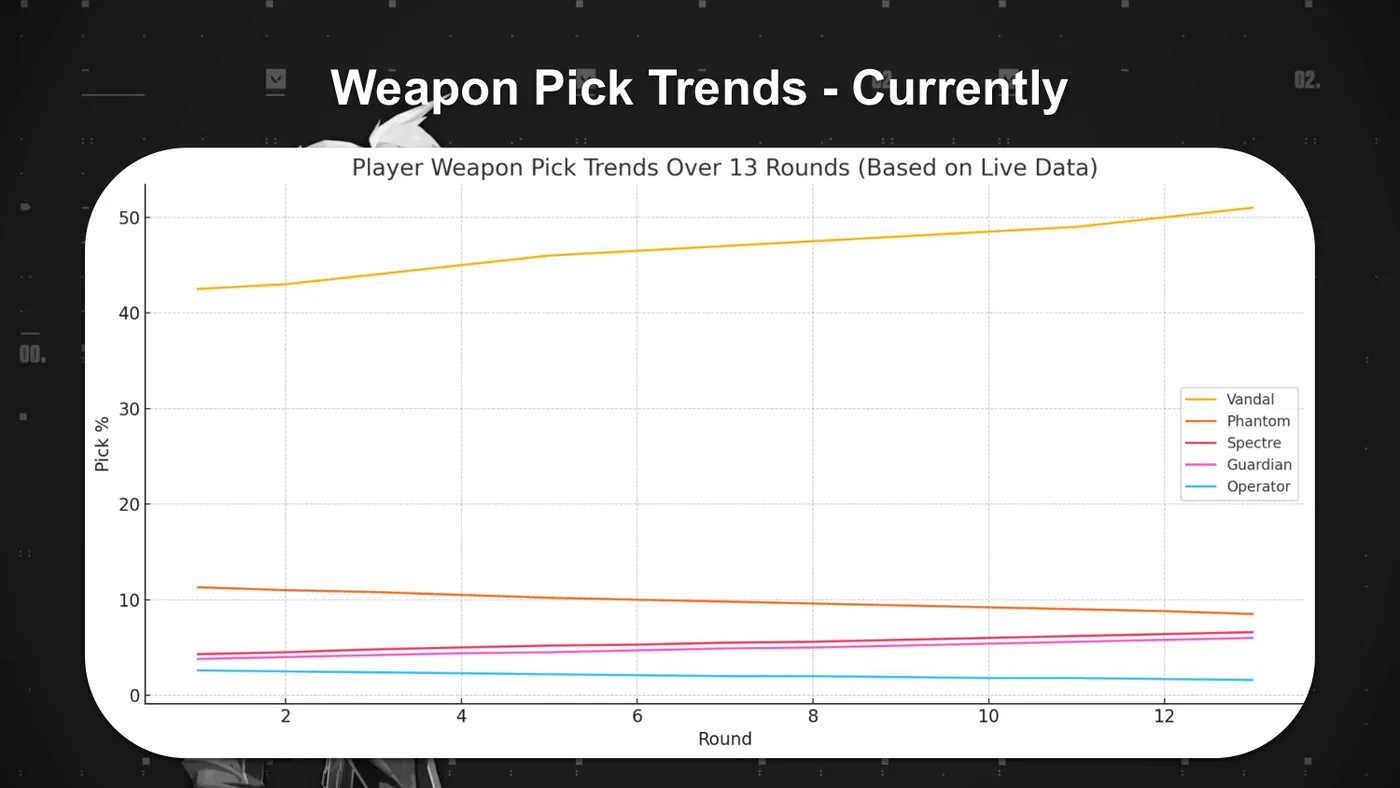
A one-weapon meta at the 2900 tier. The Vandal climbs from roughly 42% to 51% and keeps going. The Phantom - same price, same slot, its direct competitor - falls from about 11% to under 9%. The Spectre and Guardian sit in low single digits. The Operator barely registers at around 2%.
Two rifles cost exactly the same, and by the back half of the round set one of them is picked five times more often. The buy menu is presenting a choice that most players stopped making a long time ago.
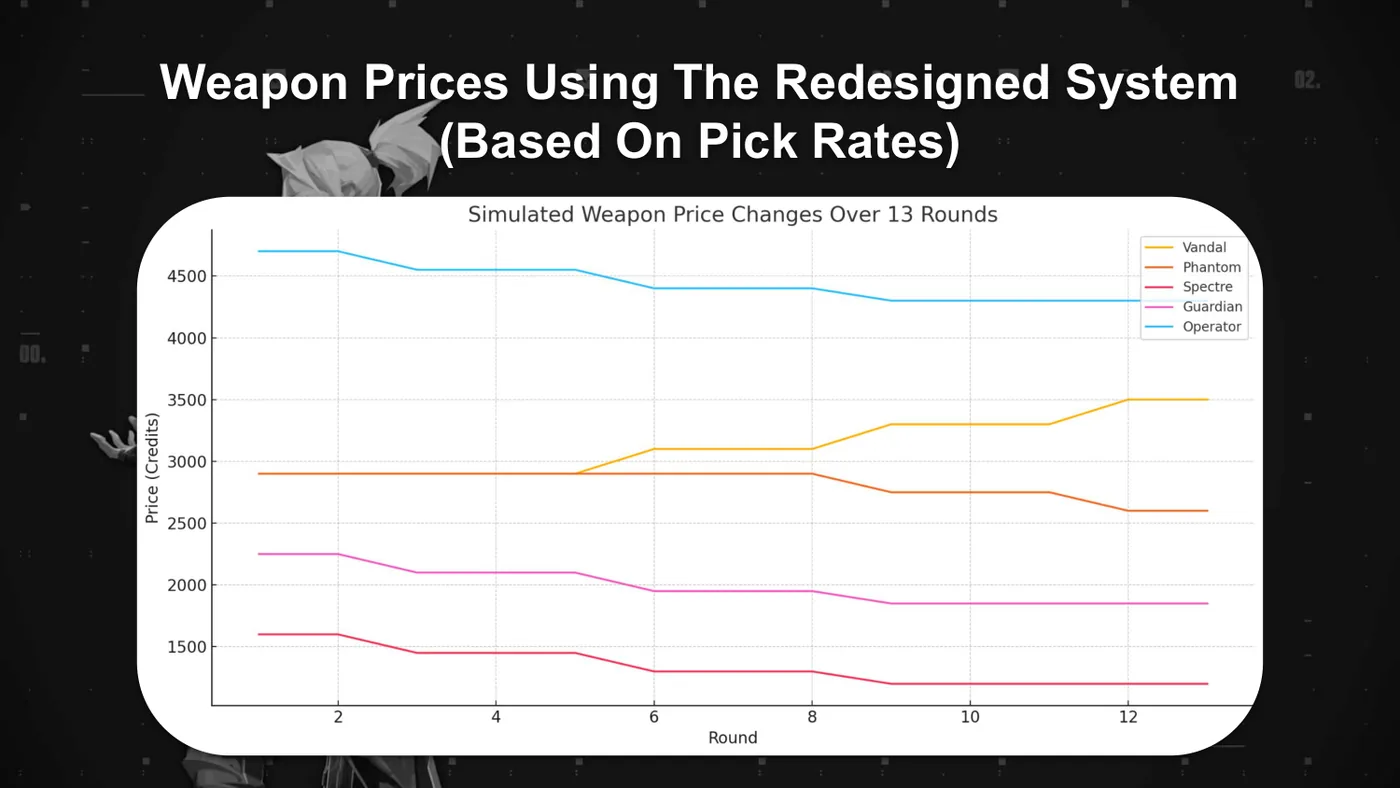
Simulated against those same rates. Running my rules over the measured data, the Vandal walks to its +600 ceiling at 3500 by round 12 while the Phantom settles at 2600. That is a 900-credit gap between two guns that are identically priced today - enough that taking the Phantom becomes an economic decision rather than a preference.
The Spectre and Guardian fall to their floors, which is the intended behaviour: unpopular weapons get cheap enough to be worth gambling on during a thin buy.
The Case Against My Own Proposal
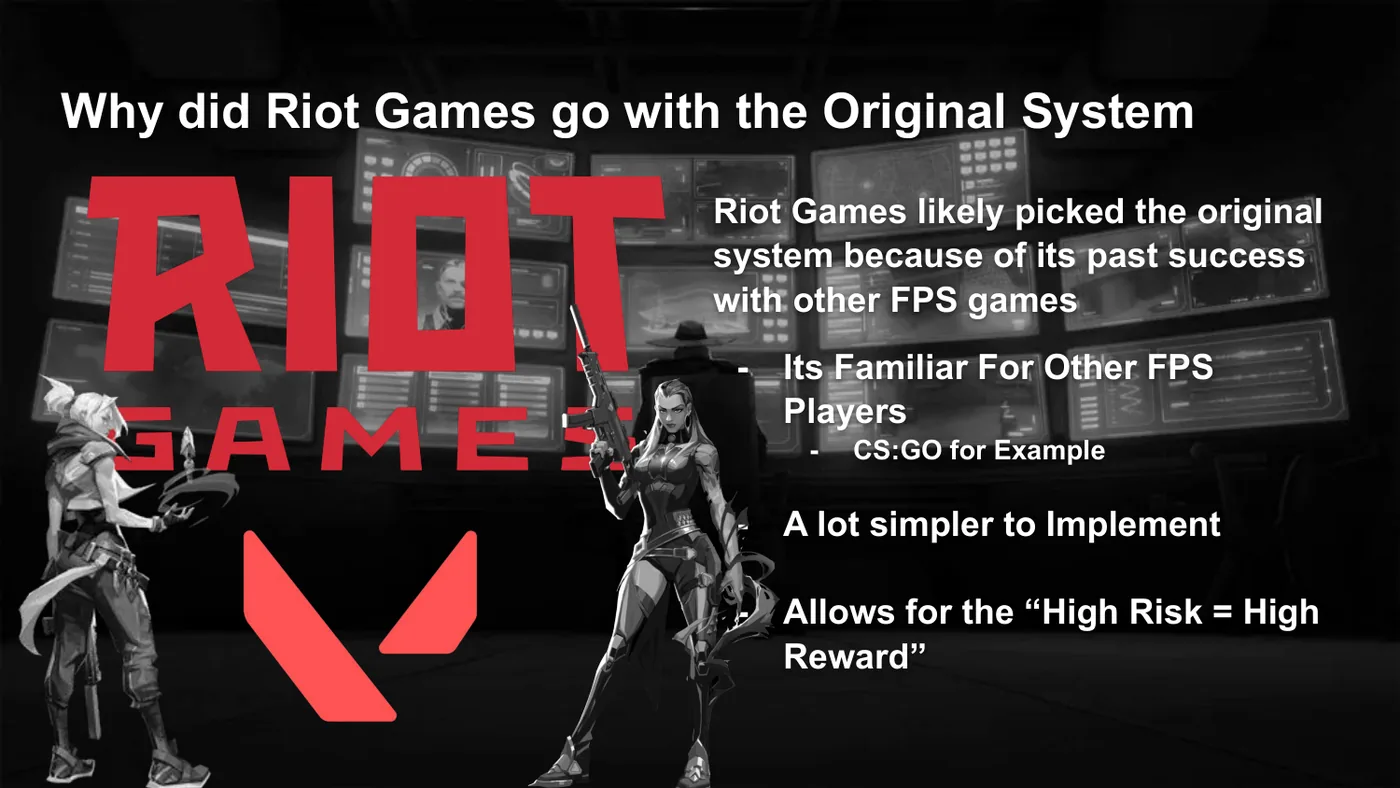
I spent a section of this deck arguing for the system I was trying to replace. A static economy inherits an intuition that CS players already have, which matters enormously for a game competing directly for that audience. It is far simpler to implement, tune and explain. And it gives a clean read on risk and reward: you know exactly what a buy costs and exactly what losing it costs.
Any dynamic system trades that legibility away. I still think the trade is worth testing, but the burden of proof sits with the change, not the incumbent. A redesign I cannot argue against is not finished.
What the Data Changed About My Argument
I began where most players begin - snipers, Operators every round, the loudest grievance in any lobby. Then I charted it, and the Operator turned out to sit at roughly 2% pick rate, the lowest weapon I tracked, flat across the entire half. The felt problem and the measured problem were not the same problem.
What the data does show is single-weapon dominance at the 2900 tier, and that is the version of this project I would defend. It also means the rules need a floor exclusion at the top of the weapon table: discounting something as strong as the Operator purely because it is rarely bought would be the same mistake in reverse. Exclusion by price band already exists in my spec for weapons under 1000 credits. It belongs at both ends.
Dynamic pricing is regressive. A 200-credit surcharge is noise to a team on a full buy and decisive to a team scraping toward one. It taxes the poorer team harder. Any serious version has to answer that, most likely by scaling adjustments against a team's current economy rather than applying them flat.
The measurement is the design. "Above 45% pick rate" is not a rule until you say measured across what population and what window. Global rates feel arbitrary inside your match; in-match rates give you ten players over three rounds, where one person can move the whole market.
It has an esports cost. VALORANT is a spectator game. A moving economy means teams prepare against a shifting target and viewers lose a stable frame for reading a buy round. I would ship this to ranked long before arguing for it in VCT.
Where This Sits
This is one of five VALORANT studies I chose across four years of my Honours Bachelor of Game Design at Sheridan. I picked the same game all four times, and nobody assigned it to me once. Read all five in order →
VALORANT, its characters, art, and related marks are the property of Riot Games, Inc. This is an independent student study, produced for coursework at Sheridan College, and is not endorsed by or affiliated with Riot Games.